
Featured Optical & Electrochemical Process Sensors
Pre-calibrated in-house, burn-in tested for 48 hours, and configured with direct RS485 Modbus RTU or 4–20 mA outputs for immediate system integration.

High-Temperature S8 Connector pH Sensor
Precision high-temperature glass electrode engineered with dual ceramic diaphragms, S8 process head, and high-stability gel reference electrolyte.
Request B2B Pricing
Fermentation High-Temp pH Sensor
Autoclave and CIP/SIP resilient bio-fermentation electrode resisting thermal cycling up to 135°C without slope degradation or signal drift.
Inquire Wholesale
High Temperature (0–130°C) pH Sensor
Integrated Pt100/Pt1000 automatic temperature compensation (ATC), pressurizable polymer reference, and robust PG13.5 mechanical thread.
View Sensor Specs
Industrial Heavy-Duty pH Electrode
Designed for harsh chemical production lines, industrial scrubbers, and electroplating baths with poison-resistant reference barriers.
Factory Direct Order
ZDYG-2088-01QX Online Turbidity & TSS
ISO 7027 compliant 860 nm infrared scattered-light turbidity sensor with integrated auto-wiper mechanism for zero-maintenance operation.
Explore Optical Sensor
pH5806 High-Temp Process Sensor
Certified Shanghai Brand electrode built specifically for bioreactors and food-grade fermentation under continuous steam sterilization.
See Technical Data
DOG-208FA High-Temp DO Sensor
Sterilizable dissolved oxygen sensor with nano-composite fluoropolymer membrane, delivering drift-free oxygen partial pressure readings.
View DO Portfolio
IOT-485 Digital Smart Electrode
Microprocessor-embedded sensor providing isolated RS485 Modbus RTU telemetry without external transmitters for direct PLC and SCADA integration.
IoT Sensor CatalogState of Global Turbidity & Suspended Solids Electrochemistry (2025–2030)
How precision optical nephelometry and factory-integrated manufacturing address tightening municipal discharge limits and smart industrial water stewardship.
In modern continuous water analysis, turbidity measurement has shifted from intermittent manual grab-sampling to autonomous, optical solid-state instrumentation embedded with edge calibration algorithms. As global regulatory bodies—including the United States EPA, the European Union under the Industrial Emissions Directive (IED), and regional environmental authorities—tighten allowable nephelometric turbidity unit (NTU) limits below 0.1 NTU for potable supplies and enforce continuous Total Suspended Solids (TSS) records for discharge permitting, water managers cannot afford sensor downtime or optical drift.
A high-performance turbidity electrode operates as an electro-optical transducer. By deploying narrow-band near-infrared (NIR) light-emitting diodes (LEDs) centered at 860 nm in strict conformance with ISO 7027-1:2016, industrial-grade turbidity sensors isolate scattered particulate photons from background sample coloration, humic acids, and ambient luminescence. For municipal clarifiers, mining reclamation circuits, and biopharma bioreactors, partnering directly with an established original equipment manufacturer (OEM) factory provides the dual advantage of tailored optical path lengths (0–10 NTU up to 0–100,000 mg/L TSS) and aggressive B2B wholesale pricing.
- Compliance with International Standards: Strict alignment with ISO 7027 (860 nm NIR nephelometry) and US EPA 180.1 (tungsten-halogen white light) optical geometry.
- Integrated Self-Cleaning Wiping Modules: Eliminates microbial biofilms, calcium carbonate scaling, and oily condensates via programmable mechanical silicone wipers.
- Digital Bus Native Topology: Direct embedded Modbus RTU communication over RS485 eliminates delicate analog signal leads susceptible to factory EMI.
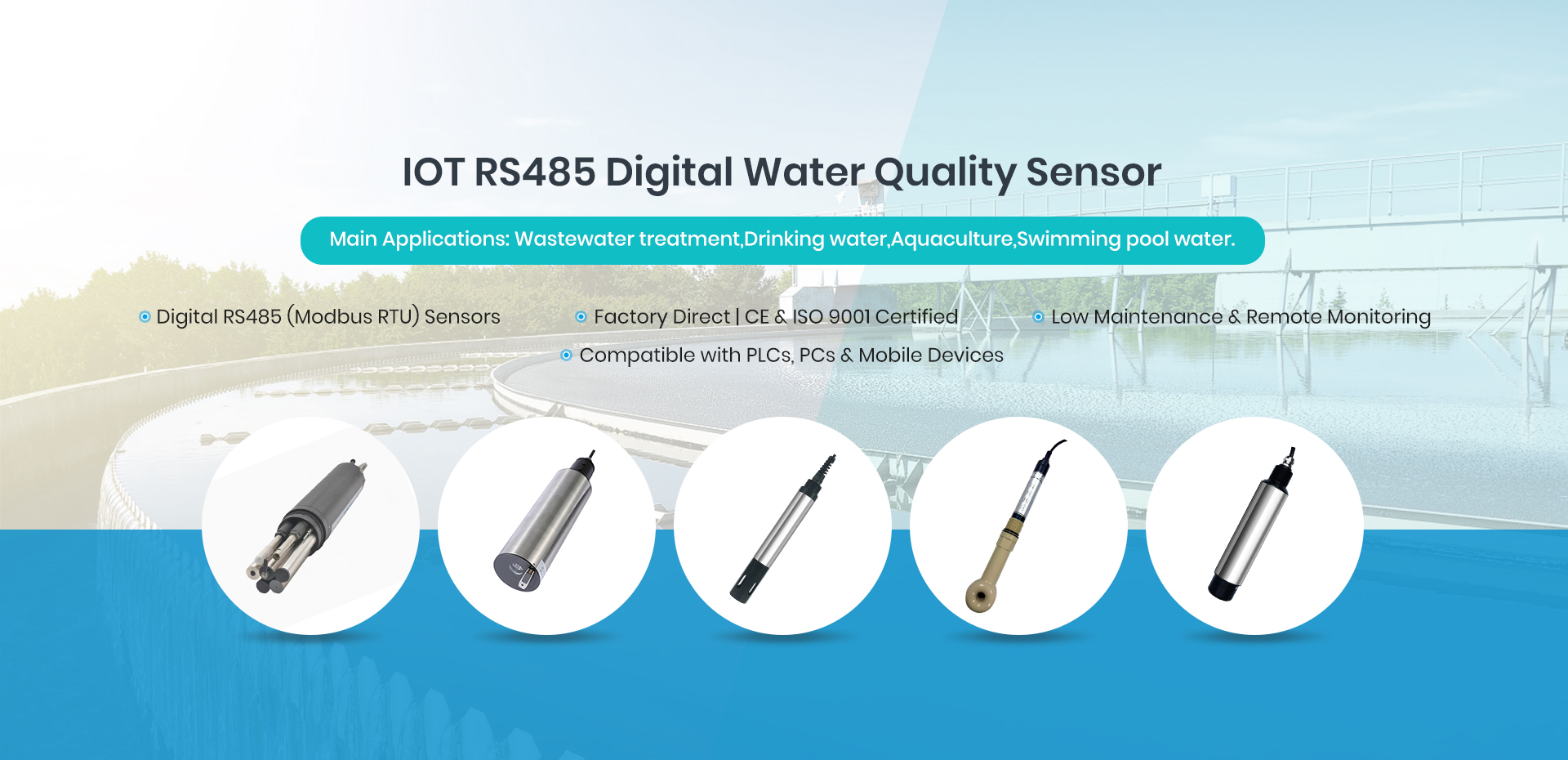
Turbidity Sensing Topologies: Nephelometric, Backscatter & Multi-Beam Ratio
Understanding optical physics and geometry to select the exact measurement principle for specific particulate concentration regimes.
90° ISO 7027 Nephelometry (0–4,000 NTU)
Utilizes an 860 nm infrared emitter and a photodiode receiver oriented precisely at 90 degrees. Ideal for raw municipal water, treated effluent, and general process monitoring, this optical geometry eliminates liquid color interference and complies directly with European drinking water mandates.
135° Backscatter TSS Probes (0–120 g/L)
Engineered for high-solids activated sludge, return activated sludge (RAS), and mining tailings where light transmission is fully attenuated. Near-infrared light is backscattered directly into wide-angle silicon detectors, providing a linear correlation with total suspended solids without optical saturation.
Four-Beam Alternating Pulsed Method
Features two alternately pulsed infrared LEDs and two discrete photodetectors. By calculating the mathematical ratio of transmitted and scattered intensity across four optical paths, the sensor automatically neutralizes optical window fouling, ambient light, and optical component aging.
Dynamic Mechanical Auto-Wiping
Equipped with a micro-stepper motor driven fluoro-silicone wiper arm that executes programmable stroke cycles (e.g., every 30 minutes). Prevents algae adhesion in open aquaculture basins and eliminates greases in food processing wastewater flumes without human intervention.
Sapphire Optical Window Assemblies
Constructed with synthetic monocrystalline sapphire lenses possessing a Mohs hardness of 9. Impervious to sand scratching in dredging slurries, caustic CIP solutions in biopharma, and high-pressure hydrodynamic cavitation inside pressurized pipelines.
High-Precision Turbidity Solutions Across Seven Global Sectors
Engineered to mitigate process downtime, assure continuous regulatory compliance, and automate dosing feedback control loops.
Municipal Potable Water Networks
Continuous monitoring at flocculation clarifier decants and dual-media filter outlets. Rapidly detects filter breakthrough, sand migration, and coagulant under-dosing, holding distribution mains consistently below the strict 0.1–0.3 NTU limits demanded by international drinking water health directives.
Industrial Wastewater Treatment (ETP)
Robust deployment in aerated basins, sequencing batch reactors (SBR), and final outfalls. Real-time TSS telemetry enables automated polymer flocculant dosing, optimizes sludge retention time (SRT), and guards against massive environmental regulatory fines caused by clarifier solids carryover.
Thermal & Nuclear Power SWAS
Steam and Water Analysis Systems (SWAS) require trace-level turbidity verification across boiler feedwater, steam condensate return, and cooling tower blowdown. Detects colloidal silica precipitation and ferric oxide particulates before they coat supercritical boiler tubes and turbine blades.
High-Density Recirculating Aquaculture (RAS)
Monitors uneaten feed pellet breakdown, faecal matter accumulation, and micro-algae blooms in high-density salmon, shrimp, and tilapia farming. Automated wiper cycles eliminate organic fouling, safeguarding gill health and maximizing automated mechanical drum filter backwash efficiency.
Biotech & Fermentation Biomass Tracking
Employs optical density (OD 600/860 nm) backscatter electrodes integrated directly into bioreactor ports. Tracks microbial cell density and mycelial growth curves in real time, eliminating repetitive sterile offline sampling while maintaining batch reproducibility.
Mining Mineral Extraction & Tailings
Monitors thickener overflow clarity, leach slurry density, and settling pond decant in gold, copper, and lithium processing. Heavy-duty titanium sensor bodies with abrasion-proof sapphire optics endure high abrasive solids without optical erosion or decalibration.
Turbidity & TSS Sensor Model Comparison Matrix
Critical architectural parameters to specify when sourcing wholesale turbidity instrumentation directly from our factory production lines.
| Series Model | Measuring Principle | Calibrated Range | Body Material | Wiping Mechanism | Output Interface | Typical Industrial Target |
|---|---|---|---|---|---|---|
| ZDYG-2088-01QX | ISO 7027 NIR 90° Nephelometric | 0.01 – 4000 NTU | 316L SS / POM / Titanium | Integrated Automatic Wiper | RS485 Modbus RTU / 4-20mA | Potable Water / WWTP Outfall |
| ZDYG-2088-02QX | 135° Backscatter Optical | 0 – 50,000 mg/L TSS | SUS316L / PEEK Optics | High-Torque Wiper / Air Blast | RS485 Modbus RTU | Aeration MLSS / Sludge Thickener |
| TSS-485-PRO | Multi-Beam Pulsed Infrared Ratio | 0 – 120 g/L (0-12%) Solids | Titanium Gr. 2 / Sapphire | Solid-State Ratio Compensated | Modbus RTU / Profibus DP | Mining Tailings / Pulp & Paper |
| TURB-FLOW-10 | Low-Angle Forward & 90° Scatter | 0.001 – 100 NTU | PVDF Flow-Cell Housing | Ultrasonic Bubble Rejection | 4-20 mA Isolated + HART | Pure Water / Membrane Filtration |
| BIO-OD-600 | Dual-Wavelength NIR Absorption | 0.1 – 300 OD (Dry Cell Weight) | 316L Electropolished Ra < 0.4 | CIP/SIP 135°C Steam Stable | Digital Native / Controller Link | Fermenters / Sterile Bioreactors |
Two Shanghai Production Bases: Kangqiao & Lingang Facilities
100% in-house electrode fabrication, SMT printed circuit board assembly, optical bench alignment, and NIST-traceable multi-point calibration.
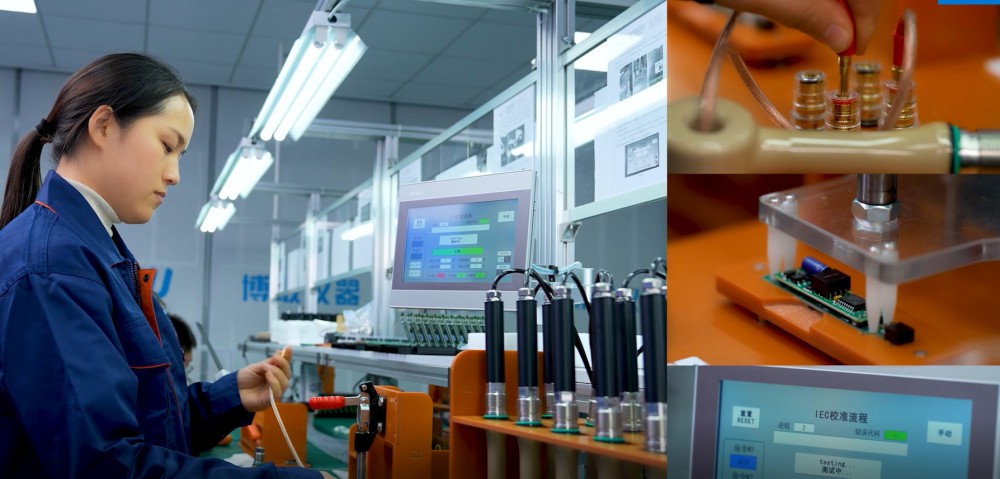
Shanghai BOQU Instrument Co., Ltd. operates as a true manufacturer rather than a white-label broker. Across our 4,632 square meters of modern manufacturing facilities in Kangqiao and Lingang, our production lines follow rigorous ISO 9001 quality management and ISO 14001 environmental management frameworks.
Every turbidity electrode undergoes optical collimation testing in dedicated dark rooms, verifying that the optical beam geometry conforms to the exact ±1.5 degree divergence tolerance specified by ISO 7027. Following optical assembly, electrodes undergo 48 hours of continuous dynamic burn-in across thermal cycling baths (0°C to 65°C) to ensure hermetic O-ring integrity and zero sensor drift prior to wholesale shipment.
- Precision Formazin & AMCO Clear Calibration: Multi-point calibration against primary EPA/ISO certified polymer turbidity calibration standards.
- Submersible IP68 & NEMA 6P Ratings: Double potted polyurethane (PU) hermetic cable entries resisting continuous water immersion up to 10 bar (100 m head).
- Full OEM / ODM Customization: Custom laser-etched branding, custom cable lengths (up to 100 m), Modbus register map programming, and titanium/Hastelloy metal fabrication.
Global Certification, Export Compliance & Regional Engineering Support
Ensuring seamless deployment through international testing credentials, robust warranty coverage, and regional channel distributor support.
International Metrological Accreditations
Every turbidity electrode model carries CE conformity, RoHS lead-free environmental compliance, and third-party audit reports from SGS. Select high-temperature and food-contact process sensors meet FDA CFR 21 177.2600 silicone and elastomer purity mandates for food and pharmaceutical bioprocesses.
Rapid Factory Lead Times & Buffer Stock
As an integrated factory, we maintain safety stock of raw sapphire lenses, optical emitters, stainless steel billet stock, and pre-potted electronics. Wholesale container shipments ship in 7–14 days, with urgent distributor air-courier replacements dispatched within 48 business hours.
Localized Field Support in 100+ Nations
Supported by a global network of specialized water instrumentation distributors, EPC contractors, and authorized system integrators across Southeast Asia, the Middle East, Latin America, Europe, and North America. Factory field application engineers provide remote Modbus commissioning and PLC register mapping assistance.
The Future of Turbidity Instrumentation: AI Drift Compensation & Edge Analytics
How next-generation turbidity electrodes incorporate optical artificial intelligence, ultrasonic anti-fouling, and low-power IoT telemetry.
Edge AI Fouling & Bubble Discrimination
Integrating ultra-fast DSP microcontrollers executing neural-network pulse analysis. By evaluating the shape and rise-time of backscattered waveforms, future sensors differentiate microscopic air bubbles and entrained micro-cavitation from actual suspended mineral particles, eliminating false high-turbidity spike alarms.
Piezoelectric Ultrasonic Self-Cleaning
Moving beyond physical silicone wipers, next-generation submerged sensors utilize high-frequency piezoelectric resonators bonded directly behind the sapphire optical window. Sub-micron ultrasonic cavitation continuously shears bio-film, fats, and chemical scaling without moving mechanical components.
Direct LoRaWAN, NB-IoT & Satellite Telemetry
Eliminating standalone transmitters, future smart turbidity probes feature integrated ultra-low-power radio modems. Remote watershed stations, environmental river monitors, and agricultural runoff catchments transmit calibrated NTU data directly to cloud SCADA platforms on small solar panels.
Frequently Asked Questions by International Engineering Buyers
In-depth technical answers addressing optical standards, maintenance routines, calibration chemistry, and wholesale procurement terms.
What is the key technical difference between ISO 7027 and EPA 180.1 turbidity measurement?
ISO 7027 requires an infrared LED light source emitting at 860 nm with a spectral bandwidth of 60 nm, detecting light scattered at 90 degrees. The 860 nm wavelength is unaffected by colored dissolved organic matter (CDOM) like tannins or humic acids. In contrast, US EPA 180.1 specifies a tungsten-halogen filament lamp operating between 400 and 680 nm (color temperature 2200–3000 K). While EPA 180.1 offers high sensitivity for ultra-pure drinking water with tiny particles, it suffers significant interference from sample color. BOQU specializes in ISO 7027 NIR sensors for global industrial reliability.
How frequently must an optical turbidity sensor be recalibrated in WWTP applications?
Due to our dual-beam pulsed infrared LED technology, BOQU optical turbidity electrodes exhibit minimal emitter aging drift (typically less than 1% full scale per year). In municipal wastewater aeration basins equipped with automated silicone wipers, zero verification with deionized water is recommended every 90 days, with full primary standard recalibration (using Formazin or AMCO Clear) required only once every 6 to 12 months, drastically lowering plant operating expenses.
Can turbidity electrodes directly measure Total Suspended Solids (TSS) in mg/L or g/L?
Yes, optical scatter correlates directly with suspended particulate mass. However, because light scattering depends on particle size distribution, refractive index, and particle geometry, the sensor transmitter features a multi-point calibration curve. By measuring representative grab samples via gravimetric EPA 160.2 lab analysis, operators input compensation coefficients into the transmitter firmware to convert optical backscatter directly into true mg/L or g/L TSS units.
What minimum order quantities (MOQ) and private-label OEM terms does BOQU offer?
For standard catalog items, we offer an MOQ of just 1 to 2 units for engineering evaluation. For OEM and private labeling partnerships (custom enclosure branding, tailored cable lengths, custom RS485 register addresses, and neutral packaging), our typical production MOQ begins at 20 to 50 units. We provide comprehensive technical dossiers, STEP 3D CAD files, and Modbus communication libraries for system integrators.
How do you handle bubble interference in pressurized industrial pipeline installations?
Entrained micro-bubbles act as powerful optical scattering centers, causing false positive turbidity spikes. For pipeline installations, BOQU recommends angled sensor insertion (45 degrees against process flow) or the use of our dedicated de-bubbling bypass flow-cell assembly (TURB-FLOW-CELL). The flow cell reduces liquid velocity, allowing air bubbles to rise and vent atmospheric gas before the sample reaches the optical measuring chamber.
What is the maximum operating pressure and temperature envelope for submersible sensors?
Standard submersible sensors with 316L SS or POM bodies operate reliably up to 6 bar (87 psi) and continuous temperatures from -10°C to +60°C. For aggressive industrial lines or chemical digestion, our high-temperature titanium and PEEK versions with sapphire optical windows withstand up to 10 bar (145 psi) and process temperatures reaching 100°C without optical de-bonding or sealing failure.
Integrated Analyzers, Multiparameter Controllers & Electrodes
Pair wholesale turbidity electrodes with our full range of field-tested industrial controllers, dual-channel transmitters, and trace-level chemistry systems.

MPG-6099Plus Multiparameter System
Integrated turnkey panel measuring turbidity, pH, residual chlorine, conductivity, and dissolved oxygen on a single high-resolution touchscreen.
View Panel System
DCA130 Online Dual Channel Controller
Combines turbidity and conductivity or pH on one compact DIN-rail/panel mount transmitter with dual 4–20 mA isolated outputs and alarm relays.
Transmitter Details
pHG-2081Pro Industrial Controller
Rugged IP65 field-mount electrochemistry instrument supporting continuous pH, ORP, and temperature monitoring with closed-loop dosing PID logic.
Explore Controller
SJG-2083CS Acid & Alkali Concentration
Electrodeless inductive conductivity analyzer engineered for chemical manufacturing, acid regeneration, and CIP caustic strength validation.
Inductive Specs
Online Residual Chlorine Analyzer
Continuous reagentless amperometric free chlorine detection for drinking water networks, food processing wash water, and disinfection control.
Disinfection Portfolio
SWAS Silicate & Phosphate Analyzer
Sub-ppb trace colorimetric wet-chemistry monitor safeguarding high-pressure boiler drums and steam turbines against silica deposition.
SWAS Trace Series
TOC-3042 Online Total Organic Carbon
Rapid differential conductivity TOC analyzer conforming with USP <643> and EP 2.2.44 for pharmaceutical purified water and WFI distribution.
Pharma TOC Specs
Online COD / TP / TN / NH3-N Analyzer
Standard digestion colorimetric outfall monitor with automated zero-calibration and regulatory tele-transmission for environmental discharge compliance.
Effluent MonitoringPartner Directly with Shanghai BOQU Instrument Co., Ltd.
Unlock direct factory wholesale tier pricing, obtain custom OEM/ODM sensor modifications, or request evaluation demonstration units for your regional distribution network.