

Thermal Stability Line
High Temp (0-130℃) pH Sensor
Integrated temperature compensation with specialized high-temperature gel electrolyte resistant to pressure fluctuation.
Explore SpecificationsDirect delivery from our Kangqiao & Lingang smart production plants. Every sensor and transmitter is validated with 48-hour continuous stability burn-in tests.
Integrated temperature compensation with specialized high-temperature gel electrolyte resistant to pressure fluctuation.
Explore Specifications
Certified CIP/SIP steam sterilization resilience up to 135℃, engineered specifically for sanitary bioreactors and culture tanks.
Explore Specifications
Polymerized solid electrolyte and annular porous PTFE junction preventing junction poisoning in aggressive chemicals.
Explore Specifications
Featuring PG13.5 threaded connection and S8 head connector for universal compatibility with standard transmitter wiring harness.
Explore Specifications
Award-winning flagship sensor for critical biopharmaceutical and pure water monitoring, built with patented anti-drift reference.
Explore Specifications
Simultaneous digital monitoring of Electrical Conductivity and pH with dual 4-20mA isolated loop outputs and dual SPDT alarm relays.
Explore Specifications
Inductive conductivity transmitter calibrated directly for H2SO4, NaOH, HNO3 chemical concentrations and clean-in-place recovery loops.
Explore Specifications
Direct RS485 Modbus-RTU output. Built-in microchip converts analog signals at the electrode, eliminating transmission interference.
Explore SpecificationsA technological paradigm shift from standard analog transmitters to multi-frequency digital edge analyzers.
Technical Insight: Modern process engineering treats conductivity transmitters not merely as scalar Ohm's-law measuring meters, but as critical real-time diagnostic systems. From micro-Siemens (0.055 µS/cm) semiconductor rinse loops to high-salinity zero liquid discharge (ZLD) desulfurization plants, selecting the optimal cell constant (K-factor) and algorithmic temperature compensation formula is crucial for process stability.
Traditional two-electrode systems often suffer from polarization resistance at higher ion concentrations. Emerging Chinese factory innovations integrate dynamic bipolar square-wave excitation algorithms (100 Hz to 20 kHz), effectively preventing ionic accumulation on platinum electrodes and enabling unprecedented linear tracking across 0.01 µS/cm to 200 mS/cm.
In highly corrosive, greasy, or crystallizing industrial fluids, contact electrode probes foul rapidly. China's top tier suppliers manufacture toroidal transformers encased in PEEK, PVDF, or Teflon. Induction of an alternating magnetic field directly measures sample ion flux without physical metal contact, drastically cutting sensor maintenance downtime.
Process plants are transitioning from bulky wall-mounted DIN-rail controllers to transmitter-in-head digital sensors. Incorporating high-resolution ADCs and RS-485 Modbus / HART transmitters directly inside IP68 submersible sensor bodies allows multi-drop wiring to DCS/PLC networks without noise degradation over long plant runs.
What international procurement engineers, EPC contractors, and OEM builders look for when auditing Chinese instrumentation suppliers.
Global pharmaceutical and power generation procurement mandates strict traceability to NIST or ASTM D1125 standards. Buyers demand factory calibration verification sheets with verified cell constants (K=0.01, K=0.1, K=1.0, or K=10.0) and automated temperature drift compensation (linear %/°C and non-linear pure water matrix algorithms).
Instrumentation exposed to demanding environments requires certified wetted parts. Global buyers look for 316L stainless steel, titanium grade 2, or Hastelloy C-276 electrodes, combined with IP65/IP66 die-cast aluminum or reinforced polycarbonate housings capable of surviving corrosive chemical vapors and tropical humidity.
Sourcing directly from tier-1 Chinese manufacturers gives international system integrators a 30-55% cost advantage over Western branded analyzers without sacrificing MTBF (Mean Time Between Failures). Agile custom manufacturing also offers delivery lead times of 1-2 weeks instead of 8-12 weeks.
Engineered sensor-to-transmitter packages tailored to specific process chemistry challenges.
| Industrial Sector | Primary Monitoring Challenges | Optimal Transmitter & Sensor Configuration | Process Benefit & ROI |
|---|---|---|---|
| Power Generation (SWAS) | Trace cation conductivity detection (<0.1 µS/cm); sample line degassing; thermal shocks. | Dual-channel transmitter with K=0.01 316L/Titanium probe, non-linear temperature compensation, cation resin exchange column integration. | Prevents corrosive pitting on boiler tubes and turbine blade deposits, preventing catastrophic unplanned shutdowns. |
| Pharmaceutical (WFI & PW) | USP <645> stage 1 uncompensated conductivity validation; SIP 135℃ steam cycles. | Hygienic Tri-Clamp K=0.1 electro-polished SS316L (Ra<0.4µm) sensor with intelligent transmitter running USP compliance software. | Ensures automated GMP validation and eliminates manual grab-sample titration risks during Water-for-Injection loops. |
| Chemical CIP & Neutralization | Extreme acid/alkali swings (up to 30% H2SO4/NaOH); aggressive scaling and coating. | SJG-2083CS Inductive Toroidal Conductivity Transmitter with virgin PEEK or PVDF wetted body. | Zero electrode fouling, automatic CIP phase separation, and chemical dosing savings exceeding 20% annually. |
| Industrial RO & Desalination | High TDS brine concentration; membrane rejection monitoring; biofouling. | 4-electrode digital conductivity transmitter with automated polarization compensation and multi-parameter Modbus telemetry. | Continuous real-time calculation of reverse osmosis membrane salt rejection percentage and early warning of membrane breakthrough. |
Meeting strict regulatory frameworks worldwide with dedicated export engineering support.
Our manufacturing plant operates under certified ISO 9001 and ISO 14001 Quality & Environmental Management Systems. All conductivity transmitters and digital controllers carry the European CE mark (EMC directive 2014/30/EU and LVD directive 2014/35/EU), RoHS environmental compliance, and FDA food-contact compliant polymers for wetted seals.
We provide full white-label and ODM instrumentation engineering for European, American, and Asian instrument brands. Custom options include bilingual interface translations (English, Spanish, Russian, French, German), custom Modbus register address maps, customized firmware algorithms for proprietary chemicals, and custom enclosure pad printing.
Zero-defect export policy: Every conductivity transmitter unit undergoes an exhaustive 48-hour continuous elevated-temperature aging test inside climatic test chambers. Electrodes and transmitters are cross-calibrated against standardized high-purity potassium chloride (KCl) reference solutions, with certified test reports provided with every shipment.
Year Founded in Shanghai
Dual Facility Production Area
Annual Sensor & Meter Output
Global Export Countries
Industrial Enterprise Clients
True manufacturing transparency for overseas engineers and procurement directors. Tour our automated sensor glassblowing stations, high-temperature calibration laboratory, SMT electronic assembly lines, and warehouse packing operations via our interactive 360° VR portal.
Explore VR Factory Tour & Audit Docs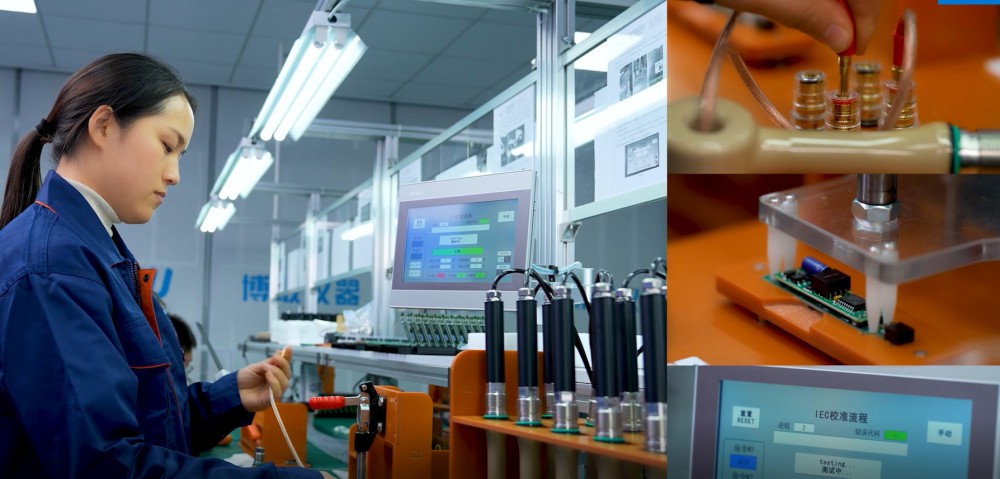
How China's leading analytical instrument manufacturers are advancing connectivity, intelligence, and edge-processing.
By capturing impedance spectroscopy (EIS) signatures during routine operation, next-gen conductivity transmitters will calculate real-time electrode surface scaling, bio-film fouling, or electrode degradation, providing maintenance teams with actionable alerts days before measurement drift occurs.
Integrating ultra-low-power radio modems directly into transmitter enclosures simplifies remote surface water and rural environmental discharge monitoring. Operating on integrated battery and solar systems, these smart nodes broadcast readings securely via MQTT/HTTPS to private cloud platforms.
Consolidating conductivity, pH/ORP, dissolved oxygen, and turbidity onto single dual-core processing units cuts industrial panel fabrication costs by 40%. Plug-and-play digital interfaces auto-detect attached sensor types and calibrate automatically without manual re-wiring.
Detailed engineering guidance directly from our factory application specialists.
Selecting the proper cell constant is critical for measurement resolution and accuracy:
Contacting sensors place metal electrodes (316L SS, platinum, or titanium) directly into the fluid. While highly sensitive in low-conductivity pure water, they can foul easily in dirty or highly concentrated fluids. Inductive (toroidal) sensors, like our SJG-2083CS, use two sealed wire-wound toroidal coils inside a corrosion-resistant polymer body (PEEK or PVDF). The fluid forms a closed loop coupling the coils. Inductive probes have no metal pins in contact with the sample, making them virtually immune to coating, fouling, and chemical corrosion in concentrated acids or wastewater.
Conductivity is highly dependent on sample temperature; fluid conductivity typically rises 1.5% to 3.0% per degree Celsius due to decreased viscosity and increased ion mobility. Our transmitters incorporate high-precision Pt100 or Pt1000 RTD temperature sensors and allow operators to select between standard linear compensation (%/℃ adjustable from 0.00 to 10.00%) or specialized non-linear matrix compensation for ultra-pure water systems to normalize all measurements accurately back to 25℃ reference conditions.
Yes. Our transmitters offer standard dual isolated 4-20mA analog current loops (representing conductivity and temperature simultaneously), RS-485 interfaces running standard Modbus-RTU protocols, and programmable SPDT relay alarm outputs. They integrate directly with Siemens, Rockwell, ABB, and Schneider PLCs, as well as IoT gateways and SCADA systems without proprietary software.
Because we operate 4,632 m² of manufacturing space across two Shanghai facilities, our standard catalog instruments have an MOQ of just 1 piece for evaluation. Standard lead time for batch orders (10–100 units) is typically 5 to 7 working days. Custom OEM/ODM requests (custom cables, branding, modified firmware) typically take 2 to 3 weeks.
Rugged online transmitters and dedicated optical sensors for wastewater effluent, municipal water distribution, and heavy chemical plants.

Polarographic dissolved oxygen electrode built for high-temperature fermentation broths subject to frequent steam sterilization cycles.
Explore Specifications
Infrared 860nm scattered light optical sensor with mechanical self-cleaning wiper, ideal for aeration basins and effluent discharge.
Explore Specifications
Turnkey wall-mount system combining conductivity, pH, turbidity, dissolved oxygen, and residual chlorine with a unified color touch controller.
Explore Specifications
Rugged IP65 industrial transmitter housing, offering wide-range pH/ORP tracking with isolated outputs and temperature drift auto-correction.
Explore Specifications
Continuous amperometric detection of free chlorine without reagent consumption, featuring integrated flow cell and automated pH compensation.
Explore Specifications
Trace-level colorimetric analyzer for thermal power plant feedwater, protecting boiler heating surfaces against scaling and deposition.
Explore Specifications
680℃ catalytic oxidation with NDIR detection for pharmaceutical purified water loops, UPW generation, and industrial wastewater monitoring.
Explore Specifications
Automated wet-chemical analyzer for environmental discharge monitoring, featuring automatic optical calibration and reagent self-priming.
Explore Specifications