
Featured Sludge, TSS & Process Analytical Sensors
Every analytical instrument is calibrated and aged for 48 hours in our Shanghai production facilities under strict ISO 9001 quality management, engineered for harsh sediment and continuous process control.

High-Temperature S8 Connector pH Sensor
Designed for heavy industrial slurries and sterile fermentation with reinforced glass membrane and stable electrolyte junction.
View Specifications →
Pharma High-Temp pH Interface Sensor
Precision pressurized reference system resistant to poisoning in high-particulate fermentation and biological sludge streams.
View Specifications →
0–130℃ pH Sensor With Integrated RTD
Dual-junction polymer gel sensor with built-in Pt100/Pt1000 temperature compensation for hot chemical sedimentation tanks.
View Specifications →
Heavy Duty Industrial High-Temp pH Sensor
Robust annular ceramic diaphragm preventing clog-up in primary clarifier feeds and chemical precipitation basins.
View Specifications →
pH5806 Ultra-Durable Analytical Sensor
Patented internal electrolyte buffer engineered for severe cycle thermal shock, high turbidity, and aggressive washdowns.
View Specifications →
DOG-208FA High Temperature DO Electrode
Critical aerobic digestion and biological sludge activation monitoring with rapid response micro-membrane mechanics.
View Specifications →
IOT-485-pH Digital Online Transducer
Internal microprocessor calculating calibration curves locally, transmitting telemetry directly to plant DCS/SCADA loops.
View Specifications →
ZDYG-2088-01QX Sludge Blanket & TSS Sensor
Infrared 860nm backscatter analyzer with motorized mechanical wiper for continuous clarifier sludge interface tracking.
View Specifications →Optimizing Sedimentation Dynamics & Sludge Interface Telemetry
An authoritative engineering examination of continuous sludge blanket measurement, hydro-acoustic phase detection, and the role of specialized Chinese sensor manufacturing in global process automation.
In modern municipal wastewater treatment plants (WWTPs), industrial effluent facilities, and metallurgical hydrometallurgy circuits, the clarification phase represents both a high-risk compliance barrier and an enormous energy sink. The sludge blanket interface—the boundary where settled flocculated particulates separate from clarified supernatant liquor—is in continuous hydrostatic flux. Failure to quantify this boundary layer leads to catastrophic effluent solids carryover, regulatory fines, excessive flocculant dosing, or uncompacted underflow pumping that overwhelms dewatering centrifuges and filter presses.
As a specialized China sludge level sensor manufacturer founded in 2007 in Kangqiao, Pudong, Shanghai, Shanghai BOQU Instrument Co., Ltd. has led the development of dual-paradigm interface detection: merging high-frequency acoustic echo-ranging (ultrasonic sonar profiling) with high-density optical attenuation (infrared 860nm backscattering). These systems overcome historic industrial limitations including floating scum interference, thermal stratification layers, and sensor fouling caused by biological slime accumulation.
The Physics of Sludge Blanket Interface Detection
Sludge blanket monitoring involves isolating two critical gradients within settling basins: the fluff layer (the transition zone where suspended solids concentration hovers between 200 mg/L and 1,500 mg/L) and the heavy bed layer (the compacted sludge underflow where solids exceed 5,000 mg/L to 15,000 mg/L). Conventional manual dipping tubes and optical sight glasses fail to provide the continuous closed-loop feedback demanded by modern PLC/SCADA automated waste activated sludge (WAS) and return activated sludge (RAS) pump stations.
BOQU's industrial sludge level instruments utilize advanced acoustic transducer algorithms. By emitting pulsed acoustic bursts in the 150 kHz to 500 kHz frequency window, the transducer tracks time-of-flight reflections against microscopic density differentials. Digital signal processors (DSP) filter out peripheral tank echoes, rake bridge rotation structures, and micro-bubble clouds, yielding an absolute, millimeter-accurate continuous depth-to-blanket reading.
Why Global EPCs Partner with BOQU's Shanghai Factories
A complete industrial ecosystem uniting precision piezoelectric fabrication, automated SMT board integration, and calibrated slurry testing rigs under one roof.
Vertical Production Integration
Unlike trading companies or simple assemblers, BOQU executes CNC machining of 316L stainless steel and PVDF sensor shells, glass blowing for analytical electrodes, and surface-mount electronics assembly across our dual Kangqiao and Lingang workshops.
Dedicated High-Temperature & Sludge Lab
Home to specialized validation columns capable of recreating variable-density biological sludge, abrasive chemical precipitation, and thermal shocks up to 130°C. Every transducer undergoes multi-point calibration prior to packaging.
Agile OEM & ODM Customization
We engineer private-label firmware, proprietary Modbus register mapping, bespoke mounting brackets (flange, immersion boom, floating ball), and extended submersible cabling tailored to specific wastewater engineering specifications.
Technological Principles & Industry Trends
Selecting between Acoustic Echo Transit and Optical Scattered Light Attenuation: Matching physical sensor mechanics to clarify tank hydraulics and rheological characteristics.
| Evaluation Parameter | Continuous Ultrasonic Echo Sounder | Optical Infrared Backscatter (TSS Profiler) | Submersible Differential Pressure Head |
|---|---|---|---|
| Primary Measurement Principle | High-frequency acoustic echo time-of-flight reflecting from density interface | Near-infrared (860nm) optical absorption and 90°/140° scattered light | Hydrostatic pressure differential calculated against liquid head height |
| Target Interface Layer | Both Fluff Layer (transition) and Settled Blanket (compacted bed) | Exact real-time concentration profile (mg/L, g/L or % Total Solids) | Compacted underflow bed mass only; blind to fluff or fine suspended pin-flocs |
| Fouling Vulnerability | Low; non-intrusive sound cone traverses liquid column with automated cleaning arm | Medium; optical glass prisms require periodic wiper blade wiping (integrated) | High; pressure diaphragms clog rapidly in fibrous or biological sludge |
| Ideal Process Duty | Secondary clarifiers, Lamella plate settlers, raw water clarifiers | Aeration MLSS basins, return sludge pipelines, DAF float monitoring | Anaerobic digestor dead-bed level, basic gravity thickeners |
| Integration Output | RS485 Modbus RTU, 4-20mA, Programmable Relay Contacts | RS485 Modbus RTU, 4-20mA HART, Direct IoT Gateway Interface | Analog 4-20mA loop-powered |
Industry Trends: The Shift to AI-Powered Acoustic Echo Profiling
The global sludge measurement industry is rapidly phasing out simplistic threshold triggers in favor of full continuous echo profile analysis. Historical ultrasonic sensors suffered from false trips triggered by scrapers passing under the sensor path, floating grease balls, or rising nitrogen gas bubbles caused by denitrification. BOQU's smart digital sensors incorporate DSP echo validation: the controller maps the echo envelope across multiple cycles, mathematically isolates static scraper blade sweeps, and recalibrates sound velocity based on real-time water temperature feedback.
Engineered Solutions Across Demanding Industries
From municipal clarifiers in urban centers to abrasive mineral tailings in remote mining regions, discover how our sensors secure operational compliance.
Municipal Secondary Clarifiers
Tracking the biological blanket prevents active biomass washout during storm surges. By linking BOQU sludge level readings with variable frequency drives (VFDs) on RAS pumps, operators stabilize the Sludge Volume Index (SVI) while cutting pump power consumption by up to 28%.
Gravity Thickener Automation
Thickening relies on maximizing underflow density without stalling the central drive rake. BOQU interface monitors identify the high-density compaction layer, allowing automated sludge discharge only when solid concentration reaches the optimum dewatering threshold.
Mining & Tailings Thickening
In metallurgical leaching and mineral extraction, slurry density can destroy standard instruments. Utilizing hardened PVDF and stainless steel transducers with self-cleaning wiper assemblies, BOQU sensors deliver continuous blanket telemetry through aggressive lime and mineral suspensions.
Dissolved Air Flotation (DAF)
DAF systems demand precise measurement of the floating scum blanket as well as the settled grit interface. Our synchronized dual-channel optical sensors track both floating layer thickness and lower bed depth to optimize mechanical skimmer schedules.
Biopharma & Chemical Effluent
Industrial wastewater loaded with solvents, volatile compounds, and fluctuating pH quickly degrades standard polymer housings. BOQU provides chemically inert sensor bodies coupled with ATEX-compliant safety barriers for hazardous area installations.
Sequencing Batch Reactors (SBR)
SBR setups experience drastic level fluctuations throughout fill, react, settle, and decant stages. BOQU's tracking transducers maintain continuous lock on the dynamic sludge interface, preventing the decanter mechanism from drawing sludge into the clean water effluent discharge.
Macro Solutions: Closed-Loop Dewatering & Chemical Control
Integrating real-time sludge blanket telemetry directly into chemical coagulant dosing, energy optimization algorithms, and digital plant twins.
In wastewater management, sludge handling and dewatering represent up to 50% of total plant operational expenditures (OPEX). Flocculant polymers (polyacrylamides) are cost-intensive, and their dosage is frequently over-engineered when operators lack accurate real-time solids concentration data. BOQU instruments bridge the operational gap between sedimentation and dewatering units:
1. Dynamic Polymer Dosing Optimization
By coupling sludge bed height with underflow TSS concentration, our multi-parameter controllers feed feed-forward pacing signals to polymer dosing skids, eliminating coagulant overdosing and reducing annual chemical spend by 15% to 22%.
2. Pumping Energy Reduction
Traditional timer-based pumping often draws thin liquid supernatant into dewatering centrifuges, causing cavitation and wasting electrical power. Real-time blanket tracking triggers underflow pumps solely when thickened sludge has accumulated.
3. Compliance Safeguards & Digital Twin
Providing millisecond telemetry via Modbus RS485 and 4-20mA to cloud analytics gateways, generating early alert flags whenever bed levels exceed critical safety heights before solids carryover into natural waterways occurs.
Procurement Standards for International Buyers & EPCs
Ensure your technical tenders specify the correct mechanical, electrical, and telemetry metrics to guarantee long-term operational success.
Materials of Construction
Standard bodies must utilize corrosion-resistant 316L Stainless Steel, POM, or PVDF. Transducer acoustic windows require specialized epoxy or polyurethane matching layers resistant to hydrogen sulfide (H₂S) gas attack.
Automated Wiper Cleaning
Biological clarifiers develop biofilms within 48 to 72 hours. Specify sensors with integrated, motorized mechanical wiper arms or compressed air backwash ports to eliminate the need for weekly manual washing.
Open Telemetry Protocols
Demand non-proprietary communication interfaces. BOQU instruments natively provide galvanic isolated RS485 Modbus RTU, 4–20 mA active loops, and programmable dual high/low relays for direct interlock control.
Verified Certifications
Confirm manufacturing compliance with ISO 9001 and ISO 14001, combined with CE electrical safety and electromagnetic compatibility (EMC) certification to withstand high-voltage VFD and motor noise.
Proven Performance Across Global Installations
Operational records from industrial parks and municipal treatment plants spanning five continents.
Frequently Asked Questions: Sludge Level Instrumentation
Practical insights addressing engineering specifications, calibration routines, maintenance cycles, and purchasing protocols.
What is the functional difference between measuring Sludge Blanket Level and Total Suspended Solids (TSS)?
Sludge blanket level identifies the physical spatial position (distance or elevation from tank floor/water surface) of the settled sediment interface boundary within a clarifier. In contrast, Total Suspended Solids (TSS) measures the mass concentration of particulate matter dispersed within a specific liquid volume (expressed in mg/L, g/L, or %). Modern wastewater automation frequently integrates both: an ultrasonic transducer tracks the rising and falling blanket boundary, while optical TSS probes measure the density of the underflow pumped to the dewatering centrifuge.
How does the ultrasonic sludge level sensor handle moving scraper rakes in circular clarifiers?
BOQU's smart digital sludge controllers utilize advanced temporal echo gating and echo-averaging DSP algorithms. When a rotating mechanical scraper arm passes directly through the acoustic beam, the controller recognizes the instantaneous step-change anomaly in echo transit time as a non-sludge mechanical artifact, holding the last valid interface reading until the scraper clears the measurement cone.
Is Shanghai BOQU Instrument a direct factory or an export intermediary?
Shanghai BOQU Instrument Co., Ltd. is a 100% direct manufacturer established in 2007. We operate two production hubs in Shanghai (Kangqiao and Lingang) covering 4,632 square meters, employing more than 200 technicians, R&D scientists, and precision assembly specialists. We produce over 100,000 analytical instruments annually with complete ISO 9001 and ISO 14001 certification.
How frequently do BOQU sludge interface sensors require routine calibration?
Ultrasonic transit-time sensors do not suffer from optical drift and generally require zero chemical calibration throughout their service life. Periodic verification involves confirming the tank depth zero-offset during dry commissioning and verifying sound velocity settings against seasonal water temperature shifts. Optical backscatter probes equipped with automatic mechanical wipers typically require verification or standard buffer checking only every 6 to 12 months.
Can BOQU sludge and analytical instruments connect directly to third-party DCS and SCADA networks?
Yes. All BOQU instruments provide open, standardized communication outputs including galvanic-isolated 4–20 mA current loops and industrial RS485 Modbus RTU. Our smart IoT digital sensor series integrates local microprocessors that transmit calibrated concentration, level, and diagnostic registers directly to standard PLC, DCS, or remote telemetry units (RTUs) without requiring proprietary secondary controllers.
What parameters and engineering details are needed to receive an exact quotation?
To ensure optimal sensor specification, please provide: 1) Clarifier or tank depth and dimensions; 2) Sludge type (primary, biological RAS/WAS, chemical floc, mining tailings); 3) Approximate solids concentration range (mg/L or %); 4) Presence of surface scum or moving scraper bridges; 5) Process fluid operating temperature and chemical composition; 6) Preferred mounting style (flange, immersion pole, or floating bracket) and cable length requirements.
Comprehensive Analytical & Quality Controllers
Complete the analytical loop with multiparameter controllers, chemical concentration meters, and online process transmitters manufactured in Shanghai.

DCA130 Online pH & Conductivity Analyzer
Compact dual-input transmitter measuring simultaneous pH and electrical conductivity with programmable alarm relays.
View Specifications →
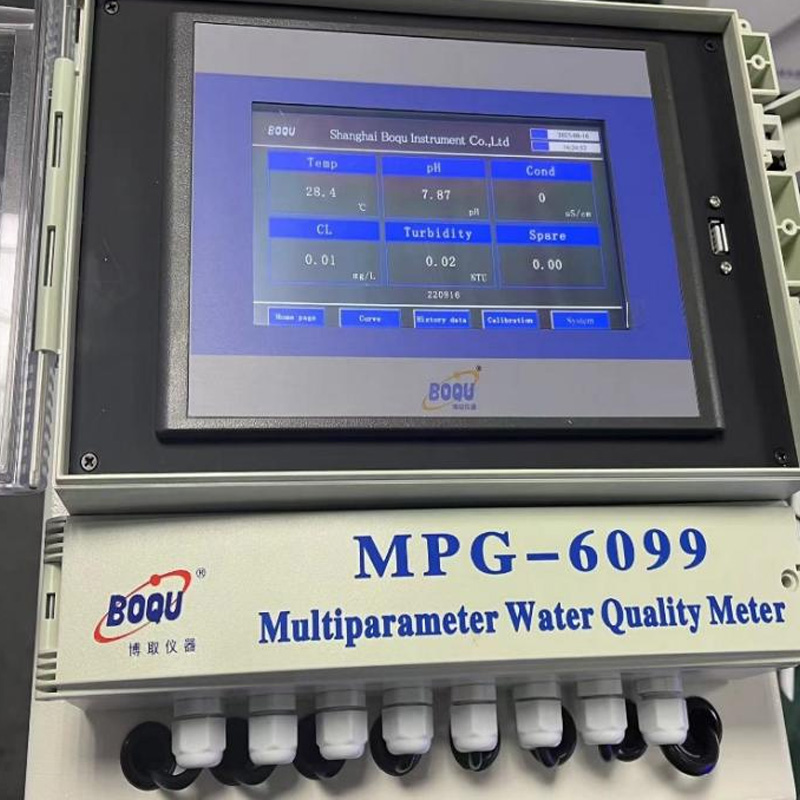
MPG-6099Plus Multi-Parameter Station
Modular wall-mount station integrating pH, residual chlorine, turbidity, and conductivity for effluent compliance monitoring.
View Specifications →
pHG-2081Pro Industrial pH/ORP Analyzer
Heavy-duty IP65 casing, menu-driven calibration, dual isolated 4–20 mA outputs, and advanced sensor health diagnostics.
View Specifications →
SJG-2083CS Acid & Alkali Concentration Meter
Electrodeless toroidal sensor measuring aggressive regenerant acids, caustic CIP cleaning solutions, and heavy chemical slurries.
View Specifications →
Continuous Free Residual Chlorine Analyzer
Constant-voltage amperometric measurement without expensive chemical reagents, with continuous pH compensation.
View Specifications →
Ultra-Trace Silicate & Sodium Analyzer
Colorimetric trace silica and phosphate detection safeguarding high-pressure steam boilers and industrial turbine stages.
View Specifications →
TOC-3042 Total Organic Carbon Analyzer
UV catalytic oxidation tracking organic loading in pharmaceutical purified water loops, UPW, and municipal influent.
View Specifications →
Online COD / TP / TN / NH3-N Analyzer
Automated wet-chemistry digestion analyzer with auto-calibration routines engineered for continuous national permit reporting.
View Specifications →Request Sludge Level Sensor Technical Specifications & Factory Pricing
Speak directly with our Shanghai application engineering team. We assist system integrators, municipal consultants, and EPC contractors in defining sensor mounting geometry, signal telemetry, and explosion-proof requirements for plant designs.