
7 Best High Temperature pH Sensors for Industrial Use

Time:2026-11-07 Author:Isabella
0%

High-temperature process lines can make pH measurement less predictable. Heat can accelerate electrode aging, while pressure, deposits, and cleaning chemicals add further strain. A standard laboratory probe may drift or fail when installed in a hot vessel. Small errors matter. They can affect dosing, product consistency, and maintenance schedules. A High Temperature pH Sensor must match the actual process, not just a temperature figure on its label.

This guide compares seven sensor options for industrial use, with attention to operating temperature, pressure limits, wetted materials, reference design, and installation requirements. It also considers transmitter compatibility and the practical demands of calibration and routine cleaning. A maximum temperature rating does not necessarily indicate reliable continuous operation at that temperature. Check the manufacturer’s specifications against the process conditions, including temperature changes during cleaning or shutdown. No probe is perfect. Real installations are not always tidy, and a sensor that performs well in one fluid may struggle in another. The best choice depends on the application, and engineers should confirm compatibility before installation.
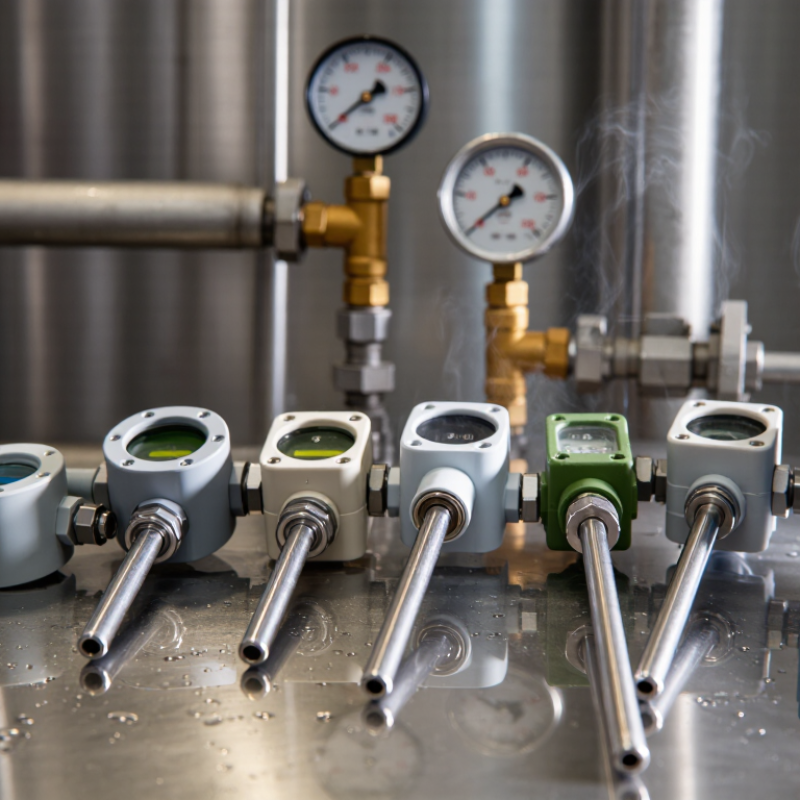
7 Best High Temperature pH Sensors for Industrial Use

Measurement Principle: 59.16 mV per pH Unit at 25 °C

A high-temperature pH sensor does not keep the same electrical response as it heats up. At 25 °C, the ideal Nernst slope is 59.16 mV per pH unit. The value follows 2.303RT/F, so it rises with absolute temperature; at 100 °C, it is about 74.0 mV per pH unit. This is a theoretical slope, not a promise of field accuracy. IUPAC’s 2002 recommendations on pH measurement explain why calibration, temperature, and traceability matter. ASTM E70 also sets out a standard method for measuring aqueous-solution pH. That matters.

Tips: Check the sensor’s temperature rating and compensation method. Calibrate near the process temperature when practical, and record both sample temperature and buffer values. A hot pipe can hide a sluggish response.

In service, a temperature probe helps the meter adjust the expected electrode slope, but it cannot correct every problem. Fouling, a depleted reference electrolyte, or a cracked glass membrane can still distort readings. One uncomfortable detail: a stable number may be wrong if the calibration buffers were cold and the process is hot. Rinse the probe, inspect its junction, and compare readings with a suitable reference method during routine checks. Temperature compensation helps; it is not a substitute for maintenance.

Seven High-Temperature Sensor Types Compared by Temperature and Pressure Ratings

7 Best High Temperature pH Sensors for Industrial Use

Seven High-Temperature Sensor Types Compared by Temperature and Pressure Ratings

High-temperature pH sensors differ in both sensing design and process housing. Typical catalog examples include glass combination probes rated near 130°C and 6 bar; steam-cleanable probes near 140°C and 4–6 bar; and differential-reference probes near 130°C and 10 bar. ISFET sensors may reach about 125°C and 6 bar. Ceramic-junction models often approach 130°C and 10 bar. Retractable assemblies may be rated around 140°C and 6–10 bar, while specialized inline housings can reach higher pressures. These figures are examples, not guarantees. Check both limits.

Ratings can change with temperature, chemicals, seals, and installation method. A sensor rated for 10 bar at room temperature may allow less pressure when hot. For a steam line, check the full sterilization cycle, not just its peak temperature. For a pressurized vessel, confirm the housing rating and the sensor’s permitted operating pressure. It is easy to overlook this detail.

Tips: Compare temperature and pressure ratings at the same operating conditions. Ask for the manufacturer’s rating curve, then verify it against your process. Allow time for calibration checks; hot, dirty service can shift readings sooner than expected. Some installations still need trial adjustments.

Electrode Materials and Junction Designs for Hot, Corrosive Process Media

7 Best High Temperature pH Sensors for Industrial Use

In hot process lines, sensor materials and junction design often determine whether readings remain dependable. Heat changes everything. Specialized glass membranes resist thermal stress and harsh chemicals better than standard formulations. The correct glass depends on the process chemistry, temperature, and pressure. A reference system also needs materials that tolerate the sample without introducing unwanted ions.

Junctions deserve equal attention. A ceramic junction is familiar and robust, but suspended solids can gradually block its pores. Open junctions can handle some fouling conditions, though they may expose the reference electrolyte to more contamination. Double-junction designs add a barrier against aggressive media, but they are not automatically the best choice for every installation. Temperature compensation corrects electrode response; it does not correct pH changes caused by the process itself.

Tips: Confirm chemical compatibility at operating temperature, not just at room temperature. Check whether the junction can be cleaned or replaced without removing the full assembly. Small details matter. Keep calibration records, and treat unstable readings as a possible installation or maintenance issue—not only a sensor failure.

Calibration with pH 4.01, 7.00, and 10.01 Reference Buffers

High Temperature pH Calibration with 4.01, 7.00, and 10.01 Buffers

For industrial pH sensors, three-point calibration can check response across acidic, neutral, and alkaline conditions. Use fresh pH 4.01, 7.00, and 10.01 reference buffers, and record their temperature. Their stated values apply at specified temperatures; they are not fixed across the full operating range. Automatic temperature compensation adjusts electrode response, but it does not correct every chemical change in the process or buffer.

NIST reference material certificates show why traceability matters: at 25°C, certified solutions include potassium hydrogen phthalate at pH 4.005, phosphate at 6.863, and borax at 9.180. These values are documented in NIST SRM certificates, and they differ slightly from common nominal buffer labels. ASTM E70 also describes glass-electrode measurement of aqueous pH. Small differences matter. For high-temperature service, calibrate with buffers near ambient temperature unless the procedure specifies otherwise, then verify the sensor under representative process conditions.

Rinse the probe between buffers, blot gently, and wait for a stable reading before accepting each point. A buffer film carried from pH 10.01 into pH 7.00 can distort the result. Check the electrode slope and offset against the instrument’s acceptance limits, then note buffer lot, temperature, and calibration time. A rushed calibration can look convincing. It may still miss drift caused by coating, heat exposure, or a tired junction.

7 Best High Temperature pH Sensors for Industrial Use - Calibration with pH 4.01, 7.00, and 10.01 Reference Buffers

Selection guide: These are sensor and installation profiles, not specific products. Temperature and pressure limits depend on the complete sensor assembly; verify the manufacturer’s rated limits for the process.

Sensor / installation profile Suitable industrial use High-temperature considerations Key selection checks Calibration with reference buffers
1. High-temperature glass combination electrode General process monitoring in hot aqueous liquids, such as chemical production and utilities. A familiar choice for elevated-temperature service. Glass type, reference system, seals, and housing determine the usable temperature and pressure limits. Confirm process compatibility, pressure rating, temperature rating, and suitability of the reference junction for the sample. Use fresh pH 7.00 first, then pH 4.01 or 10.01 to bracket the expected sample pH. Use temperature-corrected buffer values.
2. Pressurized-reference glass electrode Pressurized process lines and samples where stable reference contact is important. A pressurized reference can help maintain electrolyte flow through the junction in demanding service; it does not remove the need to respect assembly ratings. Check reference-electrolyte compatibility, junction design, process pressure, and whether the installation supports safe maintenance. Calibrate with pH 7.00 and the buffer nearest the process pH; add the third point, pH 4.01 or 10.01, when a three-point calibration is required.
3. Differential pH electrode Hot, dirty, or chemically challenging liquids where a conventional reference junction may be prone to fouling or drift. Differential designs use a second measuring element as a reference comparison; suitability still depends on the electrode construction and process conditions. Assess coating, solids, chemical attack, cleaning method, and the instrument’s compatibility with the differential sensor. Use certified pH 4.01, 7.00, and 10.01 buffers as appropriate to the measurement range; follow the sensor and transmitter calibration procedure.
4. Retractable hot-tap assembly with pH electrode Processes that need sensor removal for inspection or cleaning without opening the line, when the assembly is designed for that operation. The retractable holder is an installation system, not a temperature rating. The electrode, holder, seals, and retraction procedure must all suit the process. Verify insertion depth, isolation and safety features, pressure and temperature limits, and approved operating procedure. Calibrate the electrode in a clean, controlled environment using pH 7.00 plus pH 4.01 or 10.01; rinse between buffers and avoid cross-contamination.
5. Flow-through inline pH sensor Continuous measurement in a sample bypass or flow cell for hot process streams. A flow cell can provide controlled sensor exposure, but sample cooling, pressure reduction, and flow rate can affect how representative the reading is. Check sample conditioning, residence time, air exposure, flow-cell materials, and whether the sample remains representative of the process. Use pH 4.01, 7.00, and 10.01 buffers at a stable temperature. Apply the certified buffer values for the calibration temperature.
6. Flat-surface or flush-mount pH electrode Vessels or lines where a flush installation helps reduce pockets that can collect solids or residue. The flush geometry can aid cleaning in suitable services, but high-temperature capability depends on the sensing surface, body, and mounting materials. Evaluate coating, abrasion, cleaning chemicals, mounting geometry, and the practical method for exposing the sensor to calibration buffers. Immerse or expose the sensing surface as specified. Calibrate with pH 7.00 and a second buffer that brackets the expected process pH.
7. Low-alkali-error glass electrode Hot, strongly alkaline aqueous samples where sodium-ion interference may affect conventional glass-electrode readings. Special glass formulations can reduce sodium error under suitable conditions; they do not eliminate all interferences or replace application-specific validation. Consider sodium concentration, alkalinity, temperature, sample matrix, and the electrode’s stated operating range. For alkaline samples, include pH 10.01 with pH 7.00; use pH 4.01 when a wider-range, three-point calibration is appropriate.

Calibration note: pH 4.01, 7.00, and 10.01 are nominal reference-buffer values commonly stated at 25 °C. Buffer pH changes with temperature, so use the certified temperature table or temperature-specific value. Temperature compensation corrects the electrode’s response; it does not automatically correct temperature-driven changes in the sample’s actual pH.

Industrial Performance Checks Under IEC 60746-2: Accuracy and Response Time

7 Best High Temperature pH Sensors for Industrial Use
Industrial Performance Checks Under IEC 60746-2: Accuracy and Response Time

Choosing among high-temperature pH sensors requires more than checking the stated operating limit. IEC 60746-2 describes how to express the performance of electrochemical pH analyzers. For a useful comparison, test each sensor against traceable buffer references and report accuracy and response under stated conditions. Keep temperature, immersion depth, and agitation consistent.

NIST’s pH Standard Reference Material documentation gives a phosphate buffer value of 6.865 at 25 °C. That value is temperature-specific; use the certificate’s temperature data when checking a heated process. A sensor that reads correctly in a room-temperature buffer may drift in a hot line. Small details matter.

Measure response time after a defined pH step, and state the criterion, such as time to reach 90% of the final reading. Record the process temperature and stabilization behavior too. A quick response is not automatically an accurate one. A clean bench test is not a hot pipe. That gap deserves attention: fouling, flow, and thermal cycling can change field performance, so lab results should not be treated as a guarantee.

7 High-Temperature pH Sensor Configurations: Accuracy and Response Time

Illustrative comparison using manufacturer-neutral configurations. Lower absolute pH error and shorter response time indicate better performance.

How to read: Each point represents one configuration. Absolute pH error is measured in pH units; response time is the time to reach 90% of the final reading. Values are illustrative, not results from actual product testing. IEC 60746-2 provides a framework for expressing pH analyzer performance; it does not certify these example values.

FAQS

What temperature and pressure ratings are common for high-temperature pH sensors?

Examples include probes rated near 130°C and 6 bar. Some differential-reference or ceramic-junction models reach about 10 bar. Ratings vary by design.

Can a sensor handle its full pressure rating when hot?

Not always. Pressure limits may decrease as temperature rises. Check the rating curve for your actual operating conditions.

What should I check for steam-cleaning applications?

Check the full sterilization cycle, including temperature, pressure, and duration. A peak-temperature rating alone may not be enough.

Which junction design works best in dirty or corrosive media?

It depends on the sample. Ceramic junctions are robust but can clog with suspended solids. Open or double-junction designs may suit other conditions, but need careful evaluation.

Does temperature compensation correct every pH change?

No. It corrects the electrode’s temperature response, not pH changes caused by the process itself.

How should I compare sensor accuracy and response time?

Use traceable buffer references and consistent temperature, immersion depth, and agitation. Define response time, such as time to reach 90% of the final reading.

Why might a sensor perform differently in a process line than in a lab?

Fouling, flow, and thermal cycling can affect field readings. A clean bench test is not a hot pipe. I may still need a field adjustment.

How can I reduce unexpected reading drift?

Check chemical compatibility at operating temperature, clean or inspect the junction, and keep calibration records. Small details matter.

Conclusion

This guide explains how a High Temperature pH Sensor measures acidity and alkalinity in demanding industrial processes. At 25 °C, the theoretical electrode response is approximately 59.16 mV per pH unit, while the actual response changes with temperature. It compares seven sensor types by their temperature and pressure ratings, helping readers match a design to operating conditions. The discussion also covers electrode materials and junction designs, with attention to how they affect durability and reliable measurement in hot, corrosive process media.

The guide outlines calibration using pH 4.01, 7.00, and 10.01 reference buffers, emphasizing the importance of suitable procedures and temperature awareness. It also describes industrial performance checks based on IEC 60746-2, focusing on accuracy and response time. Together, these topics provide a practical framework for evaluating sensor suitability, maintaining dependable readings, and understanding the trade-offs involved in high-temperature pH measurement.

Isabella

Isabella

Isabella is a dedicated marketing professional with a sharp focus on driving brand growth and engagement through strategic content creation. With an extensive background in digital marketing, she combines her passion for storytelling with her keen understanding of industry trends to deliver......